Vercel Review: The Hosting Platform That Actually Makes Your Business Faster
If you run a business online, you probably know that speed is money. When a customer clicks on your website, you have about three seconds to show them something before they get bored and leave. I have spent years building websites for clients, and for a long time, I thought I had the perfect setup. But then I found Vercel, and it completely changed how I look at website performance.
The Top Automator Rating
Before we dive into the details, here is how Vercel stacks up across the key categories that matter to us builders.
| Category | Rating |
|---|---|
| Ease of understanding | 8.5 |
| Setup & onboarding | 9.0 |
| Pricing & value | 8.0 |
| Features | 9.5 |
| Integrations | 9.0 |
| Reliability | 10.0 |
| Speed & performance | 10.0 |
| Support & docs | 8.5 |
| Customization | 9.0 |
| Usefulness / ROI | 9.5 |
For a long time, I was a loyal user of a platform called Netlify. It was great, easy to use, and fit my workflow perfectly. I was building websites using standard tools that worked well enough. But as my clients started asking for better visibility on Google and faster loading times, I shifted my focus to a technology called NextJS.
NextJS is a framework that helps websites rank better on search engines like Google. It is modern, fast, and powerful. As I got comfortable with it, I learned something important: the people who built NextJS also own a hosting platform. That platform is Vercel. Naturally, I had to see if using the creators' own platform would make a difference.
The short answer is yes. It made a massive difference.
In this review, I am going to break down exactly what Vercel is, why I switched my clients over to it, and if it is worth the cost for your business.
What Is Vercel?
 Vercel provides a high-performance infrastructure for modern web applications.
Think of Vercel as the engine room for your website. You hire a developer to build the car (the design and code), but you need a garage to park it in and an engine to make it run. Vercel is that high-performance garage.
It is a cloud platform where you put your website so the rest of the world can see it. While there are hundreds of places to host a website, Vercel is special because it is built specifically to make modern websites load instantly. It takes the code my team writes and optimizes it automatically before sending it to your customers' phones or laptops.
My Transition: From Netlify to Vercel
I did not switch overnight. I was very comfortable in the Netlify ecosystem. I was using a tool called ViteJS, and Netlify handled it beautifully. However, the digital world moves fast. I realized that for my clients to really dominate their local markets, they needed the SEO benefits that NextJS offers.
Once I started building exclusively with NextJS, I began looking for ways to squeeze every ounce of speed out of it. My research kept pointing me back to Vercel.
I decided to run a test. I took a project that was doing okay on my old host and moved it to Vercel. The results were immediate. I am not just talking about the technical numbers that developers look at, though those went up too. I am talking about the "feel" of the site. Images that used to take a split second to load were suddenly just there. Pages snapped into place instantly.
Around September 2025, I made the call to shift my primary workflow to Vercel. The performance boost was too good to ignore. When images load instantly and pages don't lag, customers stay longer. When customers stay longer, they buy more.
The Cost of Doing Business
 Vercel's Pro plan offers straightforward pricing for commercial projects.
Let's talk about money, because this is usually where business owners get stuck.
Netlify had a massive perk: you could host client websites for free, even if those sites were for businesses. You could get a lot done without spending a dime. Vercel is different. They have a stricter policy. If you are hosting a website that generates revenue (a commercial site), they want you to pay for their Pro plan, which costs $20 per month.
At first, this annoyed me. Why pay $20 when I used to pay nothing?
But then I looked at the value. That $20 ensures your site is on the fastest infrastructure available. Plus, the competition has changed. Netlify recently shifted their pricing model to a complex system based on "credits" and usage points. It became confusing and, frankly, the value proposition dropped.
Compared to that new confusing model, Vercel's pricing is straightforward and offers way more bang for your buck. You are paying for premium performance. For a serious business, $20 a month is a tiny expense for a website that loads instantly and keeps Google happy.
Features That Matter to Business Owners
Vercel is not just a dumb hard drive in the cloud; it comes with tools that help you manage your business presence.
1. Analytics That Make Sense
Google Analytics can be a nightmare to read. Vercel offers its own built-in analytics. It tells you who is visiting your site and where they are coming from. It is similar to what Google offers, but it is integrated right into your dashboard. You can check your traffic health at a glance without needing a PhD in data science.
2. Speed Insights
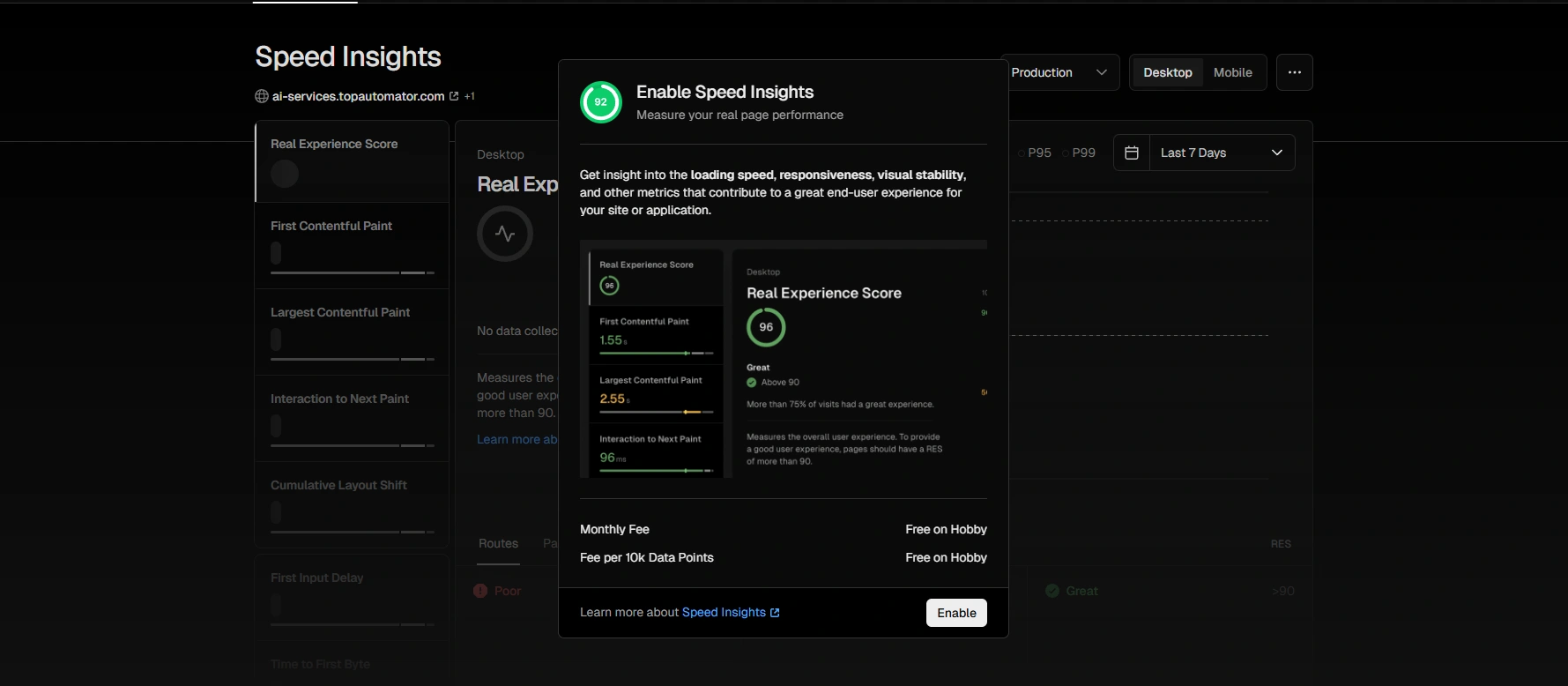 The Speed Insights tool provides real-world performance data for your website.
This is my favorite feature for clients. Vercel has a "Speed Insights" tool. It works like a health check for your website. It scores your site based on how fast it loads for real users. It is similar to Google's "Lighthouse" or "PageSpeed" scores, but it uses real-world data. It tells you exactly if your customers are having a good experience or if something is slowing them down.
3. Security and Alerts
Vercel includes observability tools. In plain English, this means it watches your website 24/7. If there is unusual activity, or if something breaks, it alerts you. You don't have to worry about your site going down and not knowing about it until a customer complains.
4. Constant Innovation
One thing I love about Vercel is their pace of innovation. Because they own NextJS, they are constantly updating the platform. They release updates almost weekly. This means your website is always sitting on the cutting edge of technology. You are not running your business on software from 2010. You are always one step ahead of competitors who are using older, slower hosting providers.
Pros and Cons
To give you a balanced view, here is what I love and what could be better.
Pros
- Incredible Speed: It is noticeably faster than other platforms, especially for image loading.
- NextJS Synergy: Since they own the framework, everything just works perfectly without complex setup.
- Real-World Analytics: Easy to understand traffic and performance data.
- Constant Updates: You are always using the latest tech without having to do anything.
- Great Uptime: I have rarely seen a site go down.
- Hybrid Hosting: You can host both web applications and static websites easily.
Cons
- Commercial Pricing: You cannot host business sites on the free tier; you must pay the $20/month subscription.
- Strict Limits: If you have a massive viral spike, you need to watch your usage limits, though this is true for all hosts.
- Learning Curve: If you are trying to manage this yourself without a developer, the dashboard can look a bit technical initially.
Rating Breakdown
Based on my transition from Netlify and my daily use of the platform for client sites, here is how I rate Vercel.
1. Ease of understanding: 8.5
For a developer, it is intuitive. For a business owner, the dashboard is clean, but it still uses some technical terms. However, the analytics section is very easy to read.
2. Setup & onboarding: 9.0
If you are using NextJS, the setup is practically magic. You connect your code repository, and Vercel handles the rest. It detects your settings and launches the site in minutes.
3. Pricing & value: 8.0
I knocked a few points off because of the forced $20 fee for commercial sites, which hurts if you are just starting out with zero revenue. However, compared to the confusing credit systems of competitors, the value you get for that $20 is excellent.
4. Features: 9.5
Between the analytics, speed insights, and automatic image optimization, the feature set is robust. It does things automatically that used to take me hours to configure manually.
5. Integrations: 9.0
It connects with everything a modern business needs, from databases to marketing tools. It integrates seamlessly with Git providers like GitHub and GitLab.
6. Reliability: 10.0
In my experience, it is rock solid. I have not had to apologize to a client for their site being offline since I switched.
7. Speed & performance: 10.0
This is the main selling point. It is top-tier. The global content delivery network (CDN) ensures your site loads fast whether your customer is in New York or Tokyo.
8. Support & docs: 8.5
Their documentation is extensive. If you do run into trouble, their support is generally responsive, though the best support is reserved for higher-paying enterprise plans.
9. Customization: 9.0
You can tweak almost anything regarding how your site is delivered. You can set up specific rules for different countries or different types of users.
10. Usefulness / ROI: 9.5
The return on investment is high. A faster site improves your Google ranking and your conversion rate. The $20 monthly cost pays for itself with just one or two retained customers who might have otherwise clicked away.
Total Rating: 9.1 / 10
Final Verdict: Is Vercel Right For You?
If you are a business owner, the answer is likely yes.
I still use Netlify for some hobby projects because their free tier is generous for non-commercial stuff. But for anything that needs to generate revenue, I always opt for Vercel. The speed difference is real, and in the digital age, speed is the most important feature you can buy.
When you combine Vercel with a modern framework like NextJS, you are essentially giving your business a Ferrari engine. It might cost a little gas money (the subscription), but the performance is absolutely worth it. You get better visibility, happier customers, and a website that feels professional and snappy.
However, owning a Ferrari engine doesn't mean much if you don't have a mechanic who knows how to install it. This isn't just about simple hosting. It is about building a high-performance architecture.
This is where we can help.
At Top Automator, we specialize in building these exact types of high-speed platforms. You might already have a website that feels slow and needs an upgrade. Or maybe you are starting with nothing and want to launch with the best technology available. In either case, we can handle the heavy lifting for you.
If you want your digital presence to be taken seriously in 2025, Vercel is the way to go. We are here to help you drive it.