Vapi.ai Review: The Developer's Choice for Voice AI
If you are navigating the current landscape of Voice AI, you have likely bounced between the big names. I know I have. My journey started heavily with Bland.ai back in August 2025. At the time, I was hesitant to move. Bland was reliable enough, and switching platforms is always a headache. But over time, the limitations of other platforms started to show, and Vapi’s rapid improvements became impossible to ignore.
I eventually made the switch, and while it hasn't been a perfectly smooth ride, it has been a fascinating one. Vapi is a powerhouse, but it is a specific kind of powerhouse. It is not the "magic wand" for everyone. It requires patience, technical know-how, and a willingness to dig into APIs.
Below is my detailed breakdown of what it is actually like to build on Vapi, from the buggy late nights to the moments of pure automation magic.
The Top Automator Rating
Before we dive into the details, here is how Vapi stacks up across the key categories that matter to us builders.
| Category | Rating |
|---|---|
| Ease of understanding | 4.8 |
| Setup & onboarding | 4.2 |
| Pricing & value | 9.0 |
| Features | 8.5 |
| Integrations | 9.6 |
| Reliability | 6.8 |
| Speed & performance | 9.8 |
| Support & docs | 3.5 |
| Customization | 9.7 |
| Usefulness / ROI | 9.5 |
The Transition: Why I Left Bland for Vapi
I was firmly planted in the Bland ecosystem for a long time. It worked, and for a while, that was enough. But as my automation needs grew, I started feeling the walls closing in. I also gave Retell a serious shot, but it felt too strict. It was like bowling with bumper rails; you are safe, but you don't have the freedom to throw a curveball if you want to.
Vapi felt different. It felt like an open sandbox. The sheer variety of voices and models available was the first hook. Unlike Retell, which keeps a tight leash on how you deploy, or Bland, which felt slightly more rigid in its model selection, Vapi gave me the keys to the car.
However, that freedom comes with a significant cost: complexity.
Is Vapi Actually No-Code?
There is a misconception floating around that Vapi is a drag-and-drop tool that anyone can use to spin up a call center in ten minutes.
It is not.
While Vapi advertises a visual builder, the reality of using it for production-grade business logic is very different. If you go in expecting a fully visual, no-code experience where you never look at a JSON payload or an API webhook, you will be disappointed.
The Missing Outbound Flow
The biggest shock for me was the outbound calling architecture. In many other tools, you can build a sequence inside the platform: Call Lead -> If they pick up, say X -> If they press 1, send SMS.
In Vapi, this internal "flow" for outbound calls is virtually non-existent. You cannot easily set up a complex outbound campaign sequence strictly within their dashboard. To get any real value out of it, you have to connect it to external automation tools.
I had to rely heavily on Make.com and n8n.
You are essentially forced to use the Vapi API to trigger calls and handle logic. This is great for control—I have massive flexibility now because I can code the logic exactly how I want in n8n—but for a user without technical skills, this is a brick wall. If you don't know how to handle a webhook or structure an API request, you will struggle to get the phone to ring.
Features: The Good, The Bad, and The Buggy
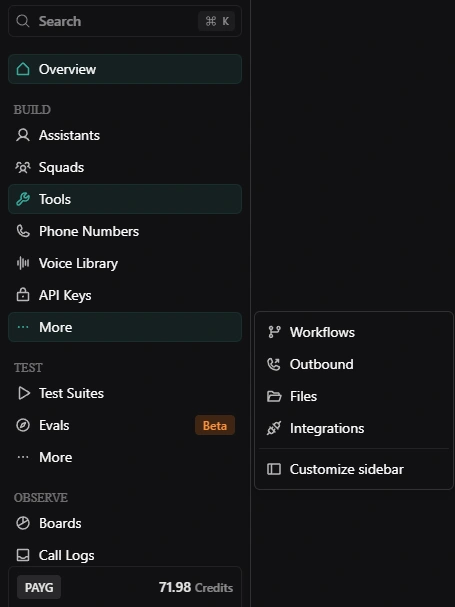 The Vapi dashboard provides a lots of features for building and managing AI Voice Agents.
Vapi is packed with features, but they vary wildly in stability. Some feel polished and futuristic, while others feel like they are still in early beta.
The Squads Nightmare
One feature I was incredibly excited about was "Squads." The idea of having multiple AI agents coordinating or handing off tasks sounds revolutionary.
In practice, it was a headache. I found it incredibly hard to understand and set up. The documentation didn't quite bridge the gap between theory and practice. When I finally did get a configuration that looked correct, it simply didn't work. It was buggy, unreliable, and eventually, I had to abandon it in favor of managing the logic myself externally.
Workflow Glitches
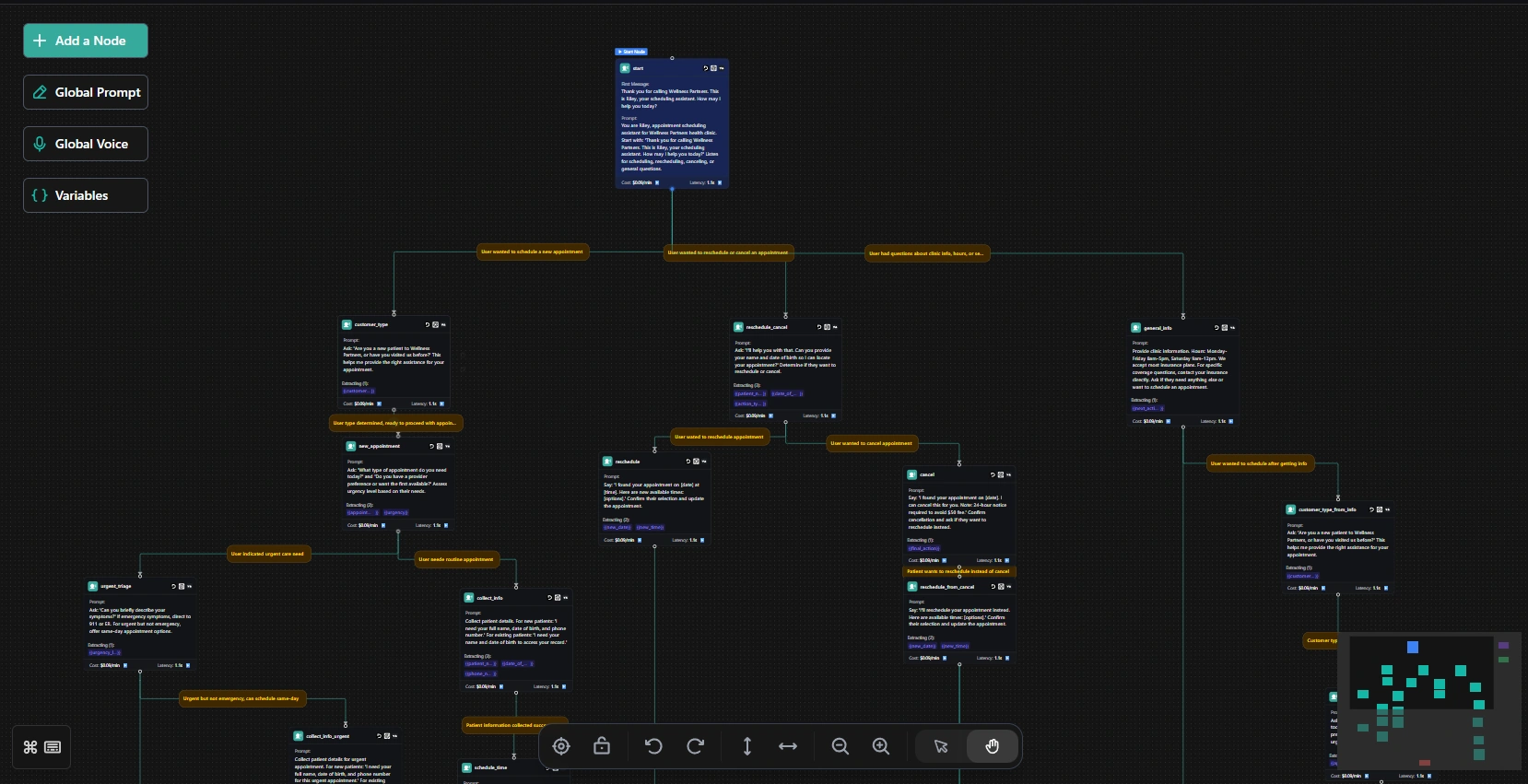 The workflow builder is where the conversation logic and agent behavior are defined.
Similarly, the internal workflows within Vapi have been hit or miss. I have experienced persistent bugs that lasted for months. The most frustration came from simple UI interactions—saving my progress. There were times I would spend an hour tweaking a prompt or a configuration, hit save, and... nothing. The progress wouldn't stick.
That said, when the platform runs smoothly, the performance is impressive. The AI responds instantly, and once configured correctly, the conversation feels completely natural.
Automated Testing: A Hidden Gem
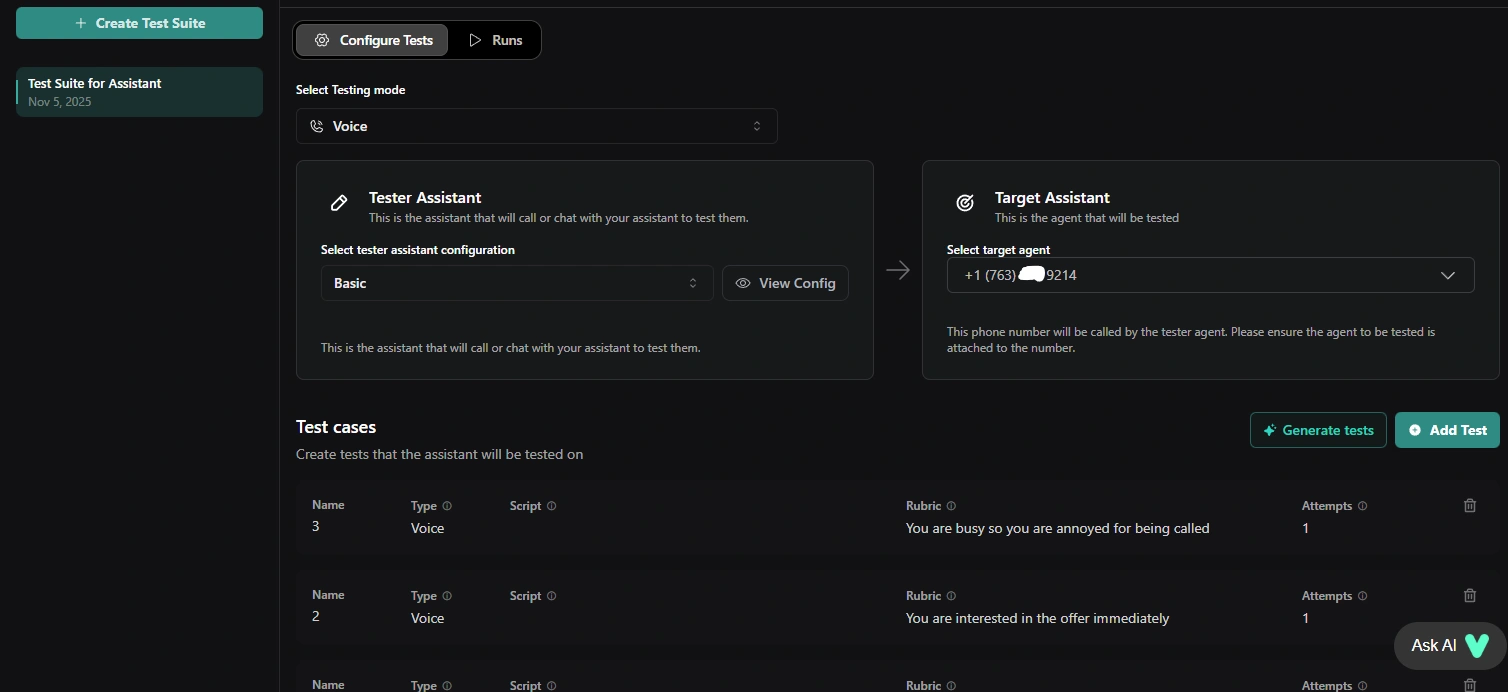 Vapi's automated testing suite is a standout feature, allowing developers to simulate calls and refine prompts without manual dialing.
On a positive note, the automated testing feature is fantastic. Being able to simulate calls and see the results instantly without having to manually pick up your phone every single time is a massive quality of life improvement.
It allows you to iterate on your prompts much faster. You can tweak the system prompt, run a test, check the output, and refine. This loop is much tighter in Vapi than in its competitors.
The Documentation Disconnect
Every developer knows that you can't build without clear instructions. Sadly, Vapi’s documentation is often confusing or incomplete, which is a major pain point.
The platform relies on passing variables into the prompt to make the AI personalized. For example, you want the AI to know the customer's name and phone number. You would assume there is a clear list of "System Variables" in the sidebar of the docs.
There isn't.
I spent ages trying to figure out how to pass the customer's phone number automatically into the prompt context. It turns out, you can do it, but the information is hidden. I actually had to ask ChatGPT to research the Vapi documentation and forums to find the specific variable syntax.
Hiding essential dynamic variables like {customer.phone} or call context data makes the onboarding process unnecessarily painful. You shouldn't have to be a detective to find out how to address your customer by name.
Comparison: Vapi vs. The Rest
To help you visualize where Vapi sits in the market, here is how I view the current landscape based on my testing.
Vapi vs. Retell
Retell is the "safe" option. It works, it is stable, but it is strict. If you want to build exactly what Retell wants you to build, it's great. If you want to build something weird, unique, or highly complex, Retell fights you. Vapi says "go ahead, break it if you want." I prefer the Vapi approach, even if it means I break things occasionally.
Vapi vs. Bland.ai
I loved Bland, but Vapi has overtaken it in terms of raw capabilities regarding models and voice selection. Bland feels a bit more like a "campaign" tool, whereas Vapi feels like infrastructure. If you are building an app on top of voice, Vapi is the better foundation.
Pros
- Model Variety: You are not locked into a small set of LLMs or voices. The selection is vast and high quality.
- Integrability: Once you get past the learning curve, the API allows you to connect Vapi to literally anything via Make or n8n.
- Testing Suite: The ability to test calls automatically is a standout feature that saves hours of development time.
- Speed: The latency is impressive. The conversations feel snappy and real, which is the most important metric for the end user.
- Continuous Improvement: despite the bugs, the team is clearly shipping code fast. The platform changes and evolves (usually for the better) every month.
Cons
- Not No-Code Friendly: The lack of an internal outbound flow builder means you must use external automation tools.
- Documentation: Key information (like prompt variables) is hidden or poorly documented.
- Stability Bugs: Issues with saving progress and buggy features like "Squads" can be frustrating.
- High Learning Curve: This is not a plug-and-play solution for marketers; it is a tool for developers and technical automators.
- Squads Feature: Currently feels too complex and buggy to be reliable for production use.
Who is Vapi For?
This is the most critical question. Vapi is not for the average business owner who wants to "turn on AI" and walk away.
Vapi is for you if:
- You are comfortable with APIs, Webhooks, and JSON.
- You use Make.com, n8n, or write your own code.
- You want total control over the voice, the model, and the latency.
- You are willing to debug occasional platform quirks in exchange for power.
Vapi is NOT for you if:
- You want a "set it and forget it" marketing dialer.
- You have zero technical staff or knowledge.
- You get frustrated when you have to read documentation to set up a phone call.
The Verdict
My switch to Vapi was necessary. The improvements in voice quality and the control I get via the API are worth the headaches.
However, the team at Vapi has a long road ahead to make this platform "professional" in the sense of user experience. The bugs needs to be squashed, the "Squads" feature needs a rethink, and the documentation needs a complete overhaul to expose the hidden power of the platform to new users.
But once you have it running? It is magic. I have built workflows now that handle thousands of calls, all orchestrated via API, and the results are better than anything I achieved on Bland or Retell.
If you have the engineering skills, Vapi is the best platform on the market right now. You just need to be prepared for a steep learning curve.
If you prefer to skip that learning curve, that is where we come in.
At Top Automator, we specialize in building these exact complex workflows. We can set up your Vapi agents, handle the n8n integrations, and ensure your system is stable from day one. You can focus on growing your business while we ensure the AI runs perfectly in the background.