Retell AI Review: Is It The Best Voice Agent Platform for Business?
Voice AI is moving fast. If you run a business, you might have noticed that text-based support is useful, but it often hits a wall. Sometimes customers just want to talk to someone. But hiring a 24/7 phone team is expensive.
That is where Retell AI fits in. It is a platform that lets you build "voice agents." These are AI systems that can answer the phone, book appointments, and handle complex conversations just like a human would.
I have spent time testing Retell AI. I wanted to see if it actually works for real business use cases or if it is just another tech toy. I ran it through its paces, set up agents, and compared it to other big players in the space.
In this review, I will break down exactly what Retell AI is, how it performs, the problems I ran into, and the things I really liked.
What is Retell AI?
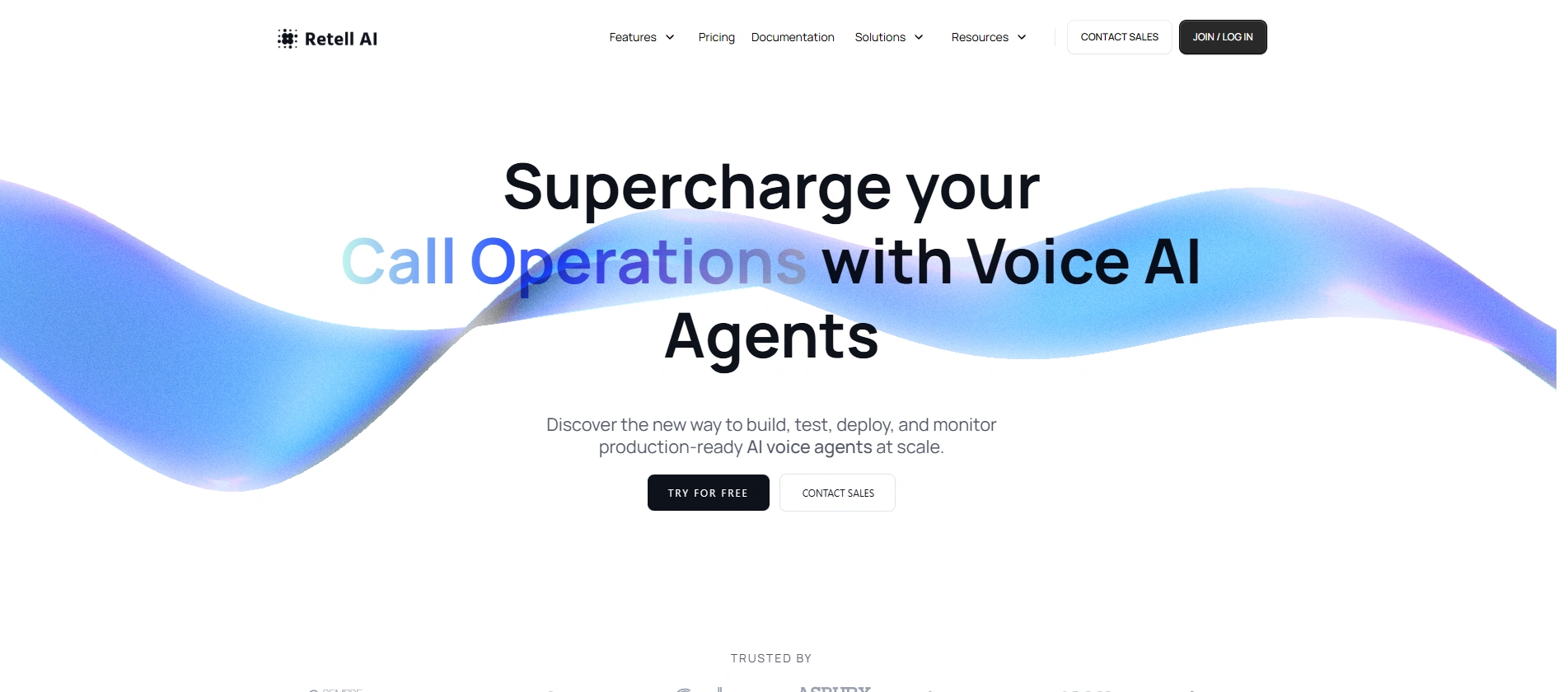 Retell AI provides a unified platform for building voice agents.
Retell AI is a developer-first platform. It is the engine that connects Large Language Models (LLMs) like ChatGPT to a telephone network.
Normally, if you wanted to build an AI that speaks on the phone, you would have to glue together three or four different technologies. You would need a transcription service (Speech-to-Text), an intelligence model (the LLM), a voice synthesizer (Text-to-Speech), and a telephony provider (like Twilio).
Retell AI bundles this all together. It handles the difficult part of making these systems talk to each other instantly.
The main focus of Retell is latency. Latency is the delay between when you stop speaking and when the AI starts speaking. If that delay is too long, the conversation feels awkward and robotic. Retell has optimized their system to get this delay down to around 800 milliseconds. This makes the conversation feel like a real back-and-forth chat rather than a walkie-talkie exchange.
The Core Functionalities
Before I get into my personal experience, you need to understand what this tool allows you to do.
Real-Time Conversation
The platform is built to handle the flow of speech. It uses a "turn-taking" model. This means it knows when you are done talking and when it should start. It keeps the conversation moving at a natural pace.
Interruption Handling
This is often called "barge-in" handling. It is one of the hardest things to get right with AI. If the AI is talking and the customer interrupts to say "Wait, no, that is wrong," the AI needs to stop immediately. Retell AI has built-in features to detect this interruption and cut the audio, listening to the new input instantly.
Flexible "Brains"
You are not stuck with one type of AI. You can connect Retell to different LLMs. You can use OpenAI’s GPT-5.2 for complex reasoning, or faster models like GPT 4o.
Voice Integration
Retell does not just use generic robot voices. It integrates with providers like ElevenLabs and PlayHT. These services provide voices that sound almost indistinguishable from humans, complete with breaths, pauses, and emotional tone.
Inbound and Outbound
You can use this for two main flows:
- Inbound: The AI acts as a receptionist. It answers calls, routes them, or answers questions.
- Outbound: The AI dials out. This is used for lead qualification, appointment reminders, or follow-ups.
My Honest Experience with Retell AI
I have tested Retell AI to see how it handles actual configuration and conversation. I also compared it directly against other tools I use, specifically VAPI. Here is the reality of using the platform.
The Design and UI
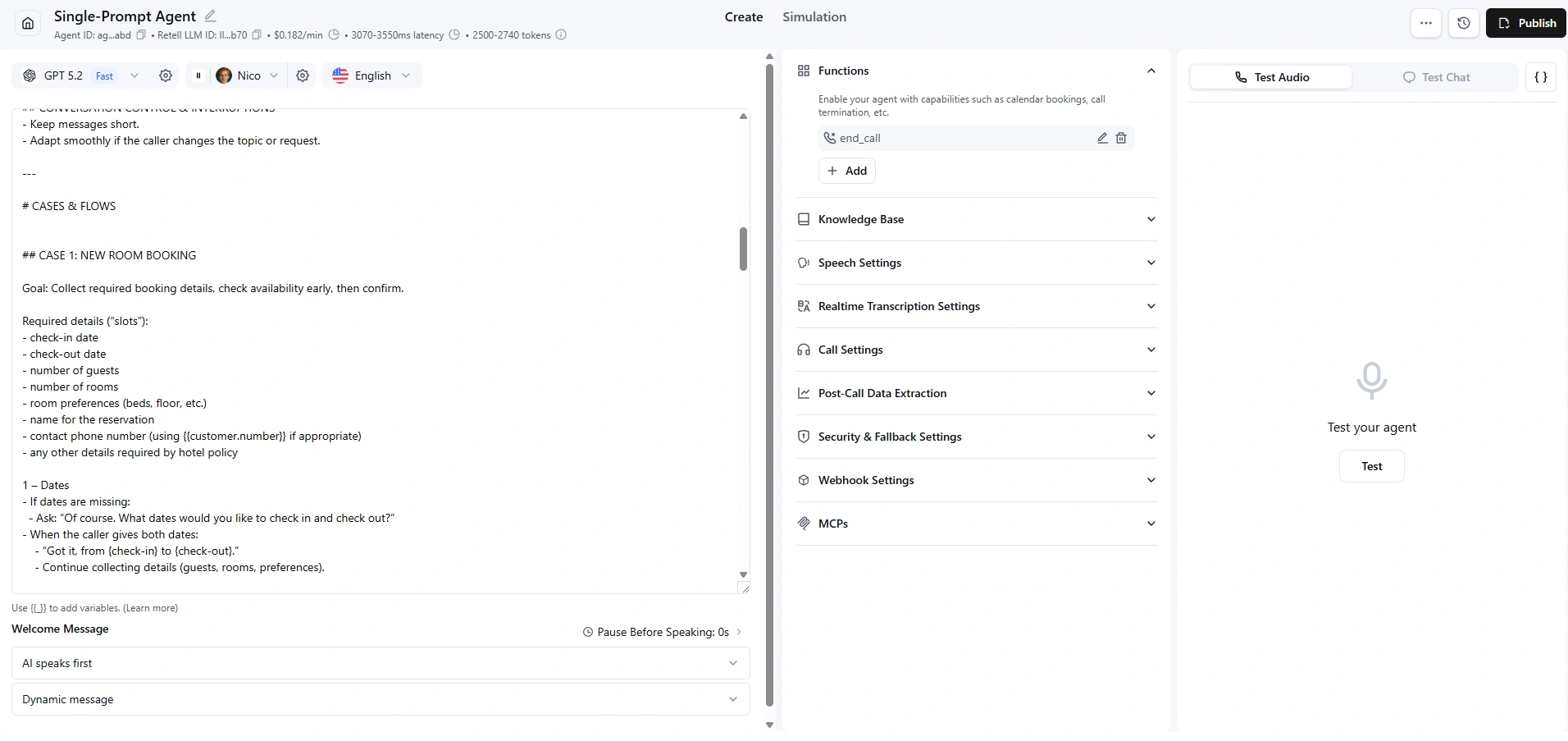 The Retell dashboard offers a clean, modern interface for managing your agents.
I have to start with the positives. I really like the design of the app.
When you log in, everything feels modern and clean. Compared to other developer tools that often look like complex spreadsheets, Retell is easy on the eyes. The layout is consistent. All the options you need are usually found in the same menu on the right side of the screen.
I found it very easy to locate specific settings. For example, if you want to toggle "AI Speaks First" or set up "Dynamic Messaging," those buttons are right where you expect them to be. You do not have to dig through endless sub-menus to find basic controls.
They are also updating the platform frequently. I noticed new features and UI tweaks popping up often, which shows the team is actively working on making the experience better. You can directly connect your webhooks, manage security settings, and handle your phone number listings very easily from the main dashboard.
The Deployment and Setup
This is where my experience turned negative. While the UI is pretty, actually deploying a bot was super confusing.
I found the setup for outbound calling to be particularly difficult. It is not intuitive. If you want to just get a testing link to send to a colleague or to test on your own phone, the process feels broken. I encountered loads of errors when trying to generate these links or set up live tests.
There is a disconnect between how good the dashboard looks and how hard it is to actually get a call live. It feels like there are hidden steps or settings that are not well-explained.
Performance and Context Quality
I ran a specific test to compare Retell against VAPI. I used the exact same prompt and almost the exact same settings on both platforms. I wanted to see which one was "smarter."
In my experience, Retell performed worse in this area.
Even though I was likely using the same underlying model (like GPT-4o, GPT-5 and GPT-5.1) on both, Retell seemed to struggle with context. It was not "listening" as well. The AI would miss details I gave it or fail to follow the specific instructions in the prompt.
For example, if I gave it a complex scenario, VAPI tended to stick to the script and understand the nuance better. Retell felt a bit looser and more prone to hallucination or forgetting what I just said.
While Retell has a great selection of voices (just like VAPI), the actual intelligence behind the voice felt weaker in my tests. It seems their implementation of the model connection might not be as optimized for context retention yet.
Pricing and Value
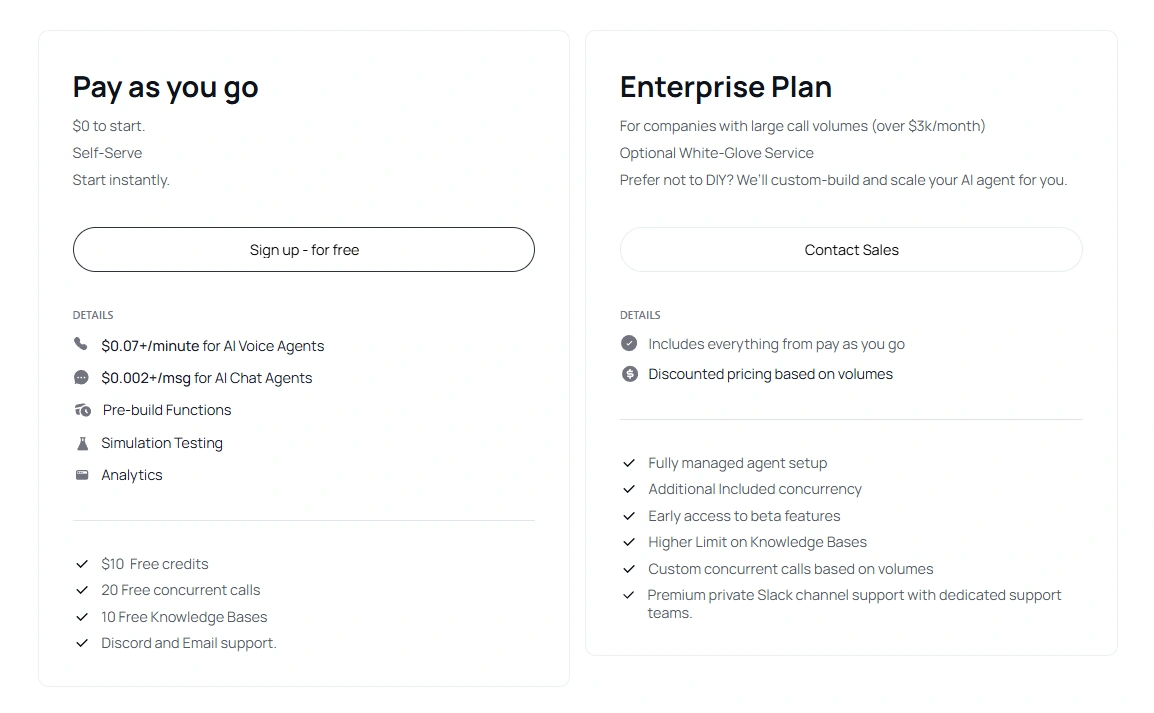 Retell AI uses a pay-as-you-go model with costs split between telephony, intelligence, and voice.
Retell AI operates on a "Pay-As-You-Go" model. This is standard for API platforms, but you need to be careful because the costs add up from different buckets.
You are paying for four things simultaneously every minute the bot is on the phone:
- Telephony: The cost to use the phone network.
- Intelligence: The cost to pay OpenAI or Anthropic for the brain.
- Voice: The cost to pay ElevenLabs or PlayHT for the sound.
- Retell Platform: The cost Retell charges to connect it all.
Use Cases: Who is this for?
Despite the setup issues I faced, the tool is still very powerful for specific businesses.
1. Local Service Businesses Dentists, plumbers, and HVAC companies can use this to answer phones after hours. You can set the prompt to collect the customer's name, issue, and preferred time, and then push that data directly to your CRM or calendar.
2. High-Volume Lead Qualification If you buy leads (like real estate or insurance leads), speed is everything. You can set up Retell to call a lead the second they submit a form. The AI can ask the qualifying questions ("Do you own the home?", "What is your credit score?"). If the lead is good, the AI can transfer the call to a real human closer.
3. Simple Appointment Management For clinics or spas, the AI can handle the back-and-forth of finding a time slot. It connects to your calendar (like Cal.com), sees what is free, and books the slot while talking to the client.
Retell AI Review: The Verdict
Retell AI is a platform with a lot of potential and a fantastic visual design. The interface is miles ahead of many clunky developer tools, and the menu system is logical and easy to navigate.
However, it currently falls short on the actual deployment experience. Setting up outbound campaigns is confusing, and I ran into too many errors during the testing phase.
More importantly, the "listening" capability and context retention felt weaker than competitors like VAPI in my direct comparisons. If you need a bot that follows complex instructions perfectly, you might find Retell frustrating to tune.
If you are a developer who prioritizes a clean UI and you are willing to work around some setup headaches, Retell is a solid choice. But if you need the absolute smartest AI context handling right out of the box, you might need to test it thoroughly before committing.
Pros & Cons
| Pros | Cons |
|---|---|
| Great UI/UX | Confusing Deployment |
| The dashboard is clean, modern, and easy to navigate. | Setting up outbound calls and test links is difficult and error-prone. |
| Consistent Menu Layout | Context Issues |
| Settings are always found on the right side, making it easy to find what you need. | In my tests, it struggled to follow prompts as strictly as competitors. |
| Feature Controls | Outbound Complexity |
| Easy toggles for "AI Speaks First" and dynamic messaging. | The workflow for dialing out is not intuitive. |
| Frequent Updates | Errors |
| The team is actively pushing new features and improvements. | I encountered bugs when generating testing links. |
| Voice Variety | Missing Granular Settings |
| Access to all the top voice providers in one place. | Some advanced settings found in VAPI are missing here. |
Ratings
Overall Rating: 7.3/10
- Ease of understanding: 7.0 The interface makes sense visually, but the deployment logic drags this down.
- Setup & onboarding: 5.5 This was the hardest part. The outbound setup and testing process needs work.
- Pricing & value: 7.5 It is expensive per minute, but standard for the industry.
- Features: 8.5 It has all the major capabilities you need like interruption handling.
- Integrations: 8.0 Connects easily with webhooks, security layers, and phone numbers.
- Reliability: 6.0 I faced too many errors during the setup and testing phase.
- Speed & performance: 7.5 The audio latency is great, but the intelligence speed/quality lagged.
- Support & docs: 6.5 The documentation could be clearer regarding the outbound setup.
- Customization: 9.0 You can tweak voices, prompts, and LLMs very easily.
- Usefulness / ROI: 7.5 If you get it working, it is a high-value tool for automation.